



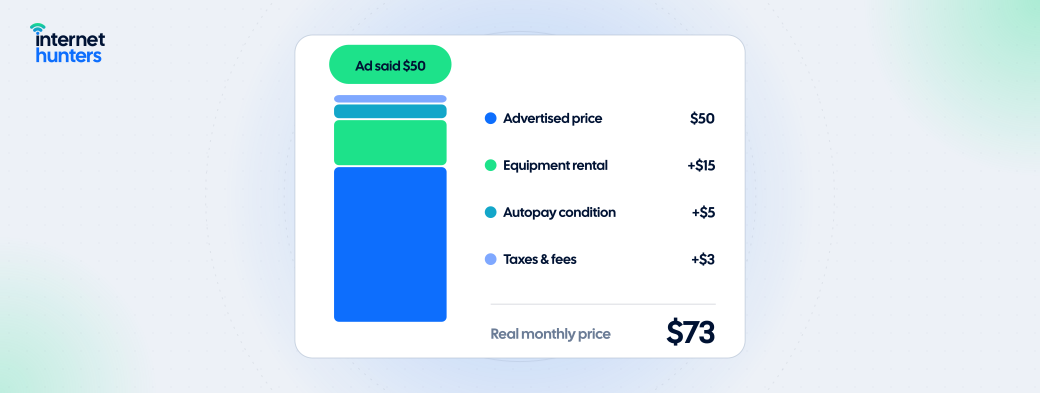
The price in an internet ad is usually a starting point, not what leaves your bank account each month. Equipment rental, setup charges, location-based fees and the price change after a promotion ends can all push your real cost well above the headline number.
The price in an internet ad is usually a starting point, not what leaves your bank account each month. Equipment rental, setup charges, location-based fees and the price change after a promotion ends can all push your real cost well above the headline number.
This guide breaks down each part of a typical home internet bill. It shows you how to estimate what a plan will cost over its first two years and which charges you can reduce or avoid before you sign up.
Where the Extra Costs Come From
Most of the gap between an advertised price and a real bill comes from a few sources:
- Promotional Pricing: A lower rate that lasts for a set period before the regular price starts.
- Equipment: A monthly charge for a modem, router or gateway, unless it’s included, or you supply your own.
- One-Time Charges: Installation, activation, or shipping fees when service starts.
- Taxes and Passthrough Fees: Location-based charges that may not be at the advertised price.
- Usage Charges: Fees for going over a monthly data allowance on plans that have one.
- Add-Ons: Optional extras such as security software, whole-home Wi-Fi packages or tech support plans.
Once you know these categories, it’s easier to ask the right questions and compare plans fairly.
1. Start With the Base Price and When It Changes
Introductory Vs. Regular Pricing
Many plans are advertised at a promotional rate that lasts 12 months or some other fixed period. Find out exactly when it ends and what the regular rate will be. A plan that looks cheaper in a month can cost more than two years than one at a steady price.
Price Guarantees
Some providers promise that a plan’s price won’t change for a stated period. Check what the guarantee covers. It may apply only to the base plan, not to equipment, fees, or add-ons.
Discounts with Conditions
Advertised prices sometimes assume you’ll sign up for automatic payments or paperless billing, or bundle internet with mobile or TV service. If you don’t meet the conditions, you’ll pay more. Ask what the plan costs without each discount.
2. Equipment: Rented, Included or Bought
Outside the plan itself, equipment is often the biggest recurring cost. It varies widely by provider and connection type.
Rental Fees
According to Tom’s Guide, many large providers, including Xfinity and Cox, charge around $15 a month for their gateway units in 2026. At that rate, a gateway costs $360 over two years.
Included Equipment
Other providers, such as AT&T and Verizon Fios, include a gateway with their internet plans instead of charging a separate rental fee. Fiber and 5G home internet usually require the provider’s own equipment, so the real question is whether it’s included or billed separately.
Buying Your Own
On many cable plans, you can use a modem and router you own. Before buying, confirm the model is on your provider’s approved list and supports your plan’s speed. If you rent extra Wi-Fi extenders or mesh units, count those fees as well. Our guide to Wi-Fi Coverage: Router Placement, Extenders and Mesh explains when you actually need them.
3. One-Time Charges at Sign-Up
Expect some or all of these on your first bill:
- Professional Installation: Often charged when a technician visit is needed, and sometimes waived during promotions.
- Activation or Setup Fee: A charge for turning on service, even with self-installation.
- Shipping: Some providers charge to deliver a self-install kit.
- Deposit: Some providers ask for a deposit when they can’t check your credit history.
Ask the provider to list every one-time charge before you place the order.
4. Taxes and Passthrough Fees
A federal law generally stops state and local governments from taxing internet access itself. Your bill can still include provider-added fees, though, along with taxes on equipment or bundled services. These charges depend on your location, so the advertised national price won’t show them. Our guide to How to Read the Broadband Facts Label explains where providers disclose these fees.
5. Data Allowances and Overage Charges
Many wired plans include unlimited data. Some plans set a monthly allowance and then charge for extra usage or offer an unlimited add-on. Households that stream in 4K, download large games or work from home use the most data. Check the allowance before you sign up, and use your provider’s app to see how much data you currently use.
6. Add-Ons That Raise the Monthly Total
Security suites, premium Wi-Fi management, static IP addresses, tech support plans and streaming bundles can all be added at sign-up and then forgotten. Some are useful. Review your account every few months and remove anything you don’t use.
7. Estimate the Real Cost Before You Sign Up
A simple way to compare plans:
Yearly cost = (monthly price × 12) + (equipment fee × 12) + one-time charges + estimated taxes and fees
Do the calculation twice: once at the promotional price and once at the regular price. Here’s an example with made-up numbers (not any provider’s actual pricing):
| Cost Item | Year 1 | Year 2 |
|---|---|---|
| Plan price | $50 × 12 = $600 | $75 × 12 = $900 |
| Gateway rental | $15 × 12 = $180 | $15 × 12 = $180 |
| Installation (one-time) | $100 | $0 |
| Total before taxes and fees | $880 | $1,080 |
| Effective monthly cost | about $73 | $90 |
The “$50 plan” really costs about $73 a month in year one and $90 in year two.
Questions to Ask Before You Order
- What is the monthly price after the promotion ends?
- Which discounts is the advertised price based on?
- Is equipment included, rented or optional?
- What one-time charges apply at sign-up?
- Which taxes and fees apply at my address?
- Is there a data allowance, and what happens if I go over it?
Know the Full Price Before You Commit
The cheapest-looking plan isn’t always the cheapest one to keep. Once you account for equipment, fees and post-promotion pricing, you can compare plans by what they’ll actually cost your household.
Internet Hunters explains the pricing, terms and technology behind home internet so you can choose with fewer surprises. Explore our guides to compare providers and plan your next decision.
Frequently Asked Questions
Why is my internet bill higher than the advertised price?
Advertised prices often leave out equipment rental, taxes and passthrough fees, and they may depend on discounts such as autopay. Your bill can also rise when a promotional rate expires.
Is it cheaper to buy my own modem?
Often, yes, if your provider allows customer-owned equipment and charges a rental fee. Compare the purchase price with the monthly fee over the time you expect to keep the service.
Do I pay for installation if I set it up myself?
Self-installation usually avoids technician fees. You may still pay an activation or shipping charge, so ask before ordering.
What does a price guarantee cover?
It depends on the provider. Many guarantees cover only the base plan price, not equipment, taxes or add-ons. Read the terms before relying on one.
How can I compare two plans fairly?
Estimate each plan’s total cost for the first and second years, including equipment and fees, rather than comparing advertised monthly prices.


