



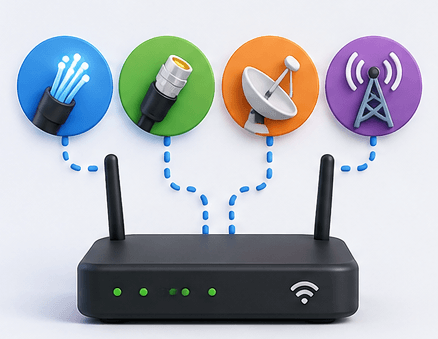
Choosing an internet plan isn't just about finding the fastest advertised speed. The type of internet connection available at your home can affect your browsing experience, streaming quality, online gaming, video calls, and even how reliable your connection is during peak hours.
Today, most households connect to the internet through one of six primary technologies: fiber, cable, DSL, satellite, fixed wireless, or 5G home internet. Each uses a different method to deliver an internet service and comes with its own strengths and limitations.
Understanding these connection types will help you make informed decisions, compare internet plans more effectively, and choose a service that fits your household needs.
What Are Internet Connection Types?
An internet connection type refers to the technology your Internet Service Provider (ISP) uses to connect your home or business to its network.
Although every connection ultimately provides internet access, the way data reaches your home varies depending on the technology. Some connections rely on physical cables, while others use wireless radio signals or satellites orbiting the Earth.
You'll often hear the term broadband when shopping for internet service.
Broadband isn't a separate connection type. Instead, it's a general term for high-speed internet services that remain continuously connected and support modern online activities such as streaming, video conferencing, gaming, cloud applications, and remote work.
Understanding the technology behind your connection explains why two plans advertising similar download speeds can deliver very different real-world performance
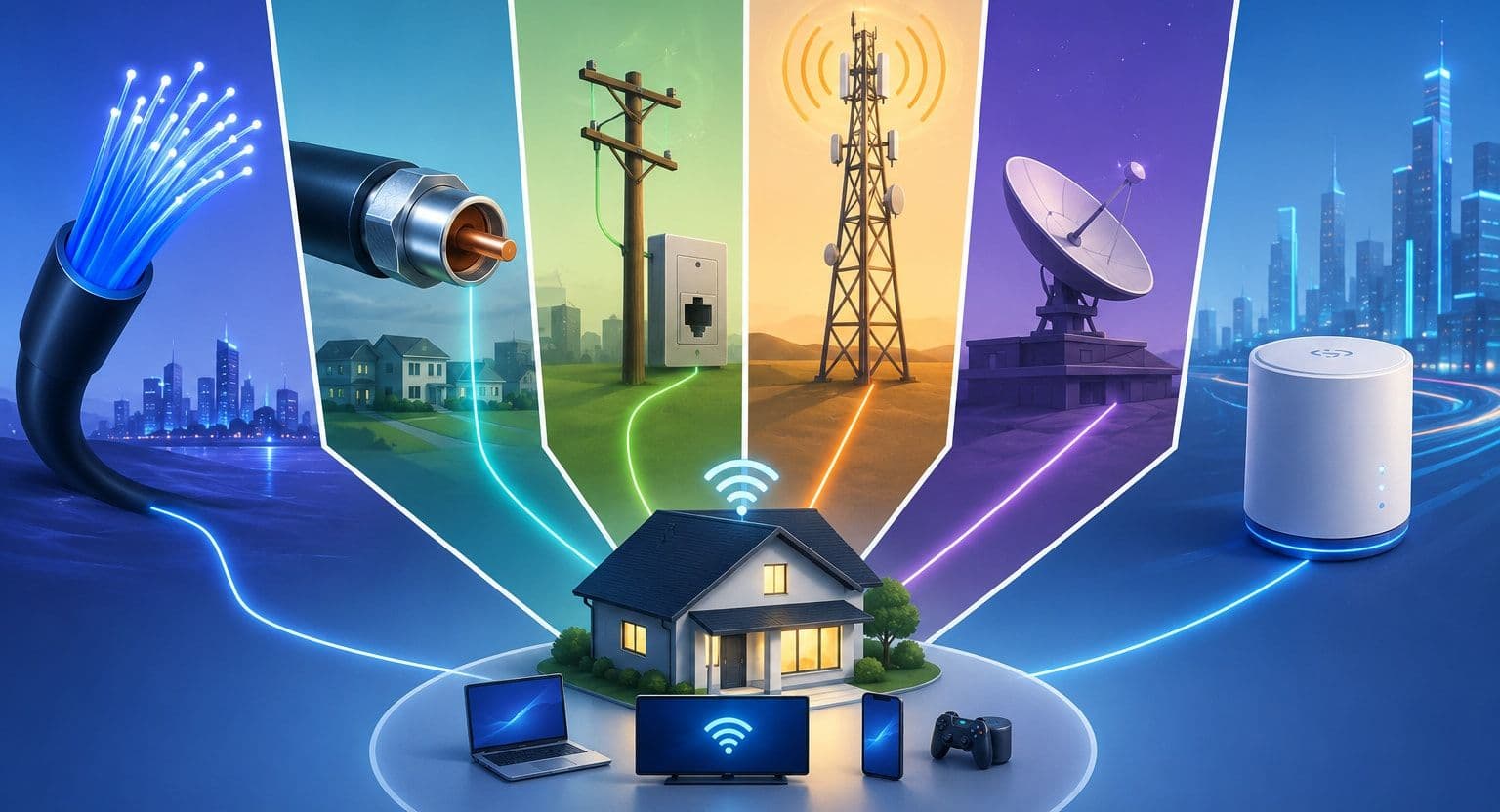
Wired vs. Wireless Internet Connections
Most internet services fall into one of two categories: wired or wireless.
Wired Connections
Wired connections deliver internet through physical cables installed between your home and your provider's network.
These include:
- Fiber internet
- Cable internet
- DSL internet
Wired connections generally offer greater stability because they are less affected by environmental conditions or signal interference.
Wireless Connections
Wireless connections use radio signals instead of physical cables to reach your property. These include:
- Fixed wireless internet
- 5G home internet
- Satellite internet
Wireless technologies have improved significantly over the past few years and have become practical alternatives in many areas where traditional wired infrastructure is limited.
Did You Know?
Many people use the terms internet and Wi-Fi interchangeably, but they are not the same. Your internet connection brings data into your home, while your Wi-Fi router distributes that connection wirelessly to your devices.
Now that you understand the difference between wired and wireless technologies, let's explore the six most common internet connection types.
The Six Types of Internet Connections
Fiber Internet
Fiber internet uses thin strands of glass or plastic called optical fibers to transmit data using pulses of light.
Unlike traditional copper-based networks, fiber is designed to carry large amounts of data over long distances with minimal signal loss. This makes it one of the most advanced internet technologies currently available.
Advantages
- Very fast download and upload speeds
- Low latency for gaming and video calls
- Reliable performance during heavy internet use
- Supports multiple connected devices with ease
Limitations
- Not available in every neighborhood
- Installation may require new infrastructure
- Availability varies by provider and location
Fiber is an excellent choice for households with multiple users, remote workers, gamers, and anyone who regularly streams high-definition or 4K content.
If you're considering a fiber connection, our Fiber Internet Guide explains how fiber works, its advantages, and what to expect during installation.
Cable Internet
Cable internet delivers internet service through the same coaxial cable infrastructure commonly used for cable television. Modern cable networks often combine fiber and coaxial cables to provide high-speed broadband to residential neighborhoods.
Cable internet is one of the most widely available connection types and offers strong performance for everyday internet use.
Advantages
- Widely available in urban and suburban areas
- Fast download speeds suitable for streaming and gaming
- Supports multiple connected devices
- Often available without extensive installation work
Limitations
- Upload speeds are typically lower than download speeds
- Performance may vary during periods of heavy neighborhood usage
- Availability depends on local cable infrastructure
For many households, cable internet provides an excellent balance between speed, availability, and cost.
Learn more in our Cable Internet Guide, where we explain DOCSIS technology, typical speeds, and how cable compares with fiber.
DSL Internet
DSL, or Digital Subscriber Line, uses existing copper telephone lines to deliver internet service.
Unlike traditional dial-up connections, DSL allows users to access the internet while using their telephone line at the same time.
Although DSL has been available for many years, it still serves areas where newer technologies like fiber or cable have not yet been deployed.
Advantages
- Uses existing telephone infrastructure
- Often available in areas without cable service
- Suitable for basic browsing, email, and light streaming
Limitations
- Speeds usually decrease as the distance from the provider's equipment increases
- Generally slower than fiber and cable
- May not meet the needs of larger households with heavy internet usage
DSL remains a practical option where higher-speed alternatives are unavailable.
Not sure if DSL is still a good option? Read our DSL Internet Guide to understand when it makes sense and when you should consider alternatives.
Satellite Internet
Satellite internet connects your home to satellites in orbit rather than relying on underground cables.
A satellite dish installed at your property communicates with satellites, which then relay information to ground stations connected to the wider internet.
Because satellite doesn't require traditional wired infrastructure, it is often available in rural and remote areas where other connection types are limited.
Advantages
- Available in many remote and rural locations
- Doesn't require cable or telephone infrastructure
- Expanding coverage in underserved regions
Limitations
- Weather conditions may affect performance
- Installation requires specialized equipment
- Performance varies depending on the satellite system and location
Satellite internet has improved significantly in recent years, making it a more practical option for users who previously had few broadband choices.
Our Satellite Internet Guide explores how satellite technology works and whether it's the right choice for rural households.
Fixed Wireless Internet
Fixed wireless internet delivers broadband using radio signals instead of underground cables. A nearby transmission tower communicates with a receiver installed at your home or business, providing internet access without the need for telephone or cable lines.
This technology has become increasingly popular in areas where laying new wired infrastructure is expensive or impractical.
Advantages
- Available in many rural and suburban locations
- Faster deployment than installing new cable or fiber lines
- Can provide reliable broadband where wired services are limited
Limitations
- Signal quality may be affected by distance or physical obstructions
- Availability depends on local provider coverage
- Speeds can vary depending on network conditions
For households without access to fiber or cable, fixed wireless can be an excellent alternative.
Want to know how fixed wireless compares with cable or fiber? See our detailed Fixed Wireless Internet Guide.
5G Home Internet
5G home internet is a newer form of broadband that uses a mobile carrier's 5G network to provide internet service to homes. Instead of connecting through traditional wired infrastructure, a wireless gateway receives the signal and distributes internet throughout the home via Wi-Fi or Ethernet.
Although 5G home internet is technically a type of fixed wireless service, it has become a distinct residential option offered by several providers.
Advantages
- Simple installation with minimal equipment
- No cable or telephone line required
- Competitive speeds in supported areas
- Suitable for streaming, remote work and everyday browsing
Limitations
- Availability varies by address
- Performance depends on signal strength and network congestion
- Speeds may fluctuate more than wired connections
As 5G networks continue to expand, this technology is becoming an increasingly attractive option for many households.
Learn how 5G Home Internet compares with traditional broadband and whether it's available in your area.
Internet Connection Types Compared
Choosing an internet connection isn't only about speed. Reliability, availability, upload performance, latency, and household usage all play an important role.
| Connection Type | Typical Speed Range | Best For | Main Advantages | Things to Consider |
|---|---|---|---|---|
| Fiber | 300 Mbps–5 Gbps+ | Heavy internet users, gamers, remote workers | Fastest speeds, low latency, symmetrical uploads | Limited availability in some areas |
| Cable | 100 Mbps–2 Gbps | Most households | Fast downloads, wide availability | Upload speeds are usually slower |
| DSL | 10–100 Mbps | Basic internet users | Uses existing phone lines | Performance decreases with distance |
| Satellite | 50–250 Mbps | Rural and remote homes | Available almost anywhere | Weather and latency may affect performance |
| Fixed Wireless | 25–300 Mbps | Rural and suburban users | No underground cable required | Signal quality depends on coverage |
| 5G Home Internet | 100–1,000 Mbps | Urban and suburban homes | Easy setup, competitive speeds | Performance varies by signal strength |
How to Choose the Right Internet Connection
The best internet connection isn't always the fastest one. It's the one that matches your household's needs and is available at your address.
When comparing your options, consider the following factors:
Availability
Not every technology is available everywhere. Fiber may be common in one neighborhood, while another may only have access to cable, DSL, fixed wireless, or satellite internet.
Always check which providers serve your address before comparing plans.
Internet Usage
Think about how your household uses the internet every day.
Fiber is ideal if you:
- Work from home
- Upload large files regularly
- Stream 4K or 8K content
- Play competitive online games
- Have many connected devices
Cable is a great choice if you:
- Want reliable everyday broadband
- Stream TV and movies frequently
- Have several people using the internet simultaneously
- Need fast download speeds at a competitive price
DSL may be sufficient if you:
- Primarily browse the web
- Check email
- Shop online
- Stream occasionally
- Live in an area without newer broadband infrastructure
Satellite or Fixed Wireless may be best if you:
- Live in a rural location
- Don't have access to fiber or cable
- Need broadband where wired infrastructure isn't available
5G Home Internet is worth considering if you:
- Want quick installation
- Have strong 5G coverage
- Prefer not to install cable or telephone lines
- Need dependable internet for everyday home use
Budget
Monthly costs, installation fees, and equipment requirements vary between providers and technologies. Compare the overall value rather than focusing only on advertised speeds.
Future Needs
Your internet needs today may not be the same a few years from now.
If your household is growing or you're adding more connected devices, choosing a higher- capacity connection now may help avoid upgrading later.
Frequently Asked Questions
What is the fastest type of internet connection?
Fiber internet generally offers the highest speeds and lowest latency where it is available.
Is fiber always better than cable?
Fiber often provides higher upload speeds and lower latency, but cable remains an excellent option for many households and is more widely available in some areas.
What type of internet is best for rural areas?
Satellite and fixed wireless internet are common choices in rural locations where fiber and cable infrastructure may not be available.
Is 5G home internet the same as mobile data?
No. Although both use cellular networks, 5G home internet is designed to provide broadband service to an entire home through a dedicated gateway.
How can I find out which internet connection types are available at my address?
Most internet providers offer online availability checkers that allow you to enter your address and view the services available in your area.


Need More Help Choosing?
Understanding the different types of internet connections is the first step toward making a smarter internet decision. Whether you're comparing providers, choosing your first broadband plan, or upgrading your current service, having the right information makes the process much easier.
At Internet Hunters, our goal is to simplify internet technology through clear, unbiased educational guides. Explore our growing library of resources to learn about internet speeds, broadband technologies, Wi-Fi, data caps, and everything you need to confidently choose the right internet service for your home.
Explore Related Guides

