



Internet Hunters is not affiliated with any internet provider mentioned in this article. Our information is independent, unbiased, and research-based, but prices and availability change, so confirm details with the provider before signing up.
Your internet bill goes up, your promotional rate expires, or a fee appears that you don't remember agreeing to. Before assuming you have to pay more—or cancel your service—there are practical ways to push back.
The goal is to understand what changed, ask for specific savings, and decide whether your current plan still offers good value. You don't need an aggressive approach or a complicated script; preparation and clear questions can make the conversation more productive.
Why Does Your Internet Bill Keep Going Up?
A higher bill doesn't always mean you're getting better service. Your monthly total can change for several reasons:
- Promotional Pricing Ended: The price you paid when you first signed up may have been temporary.
- A Discount Expired: An introductory offer, loyalty credit, or bundled service discount may no longer apply.
- Equipment Charges Add Up: You may be paying monthly rental fees for a modem, router, or gateway.
- Your Plan Includes More Than You Need: You might be paying for a faster speed tier, or add-on services your household rarely uses.
- A New Charge Appeared: Taxes, surcharges, or other fees may have changed.
Compare your latest bill with an older one. Look at the service price, discounts, equipment charges, add-ons, and total due. That gives you a specific reason to call rather than simply asking why the bill is expensive.
Before You Call, Know What You Want to Pay
1. Review Your Current Plan and Total Bill
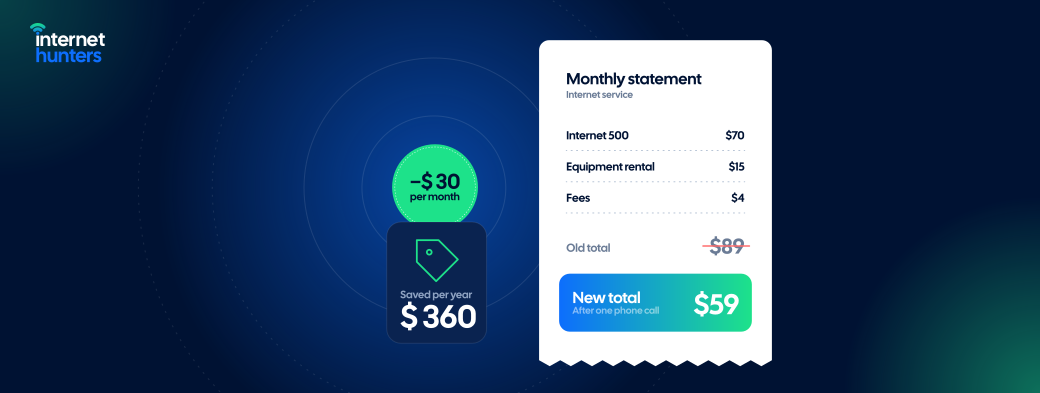
Write down your internet speed tier, monthly service price, equipment rental, discounts, and extra services. Focus on the total recurring cost—not just the advertised plan price. A plan advertised at $50 per month may cost more once equipment and other recurring charges are included.
2. Check Your Provider’s Current Offers
Visit your provider’s official website and check what it advertises for your address. Look for current customer promotions, lower-priced plans, and offers available to new customers. New customer pricing can be a useful reference point, but it does not guarantee that the same offer will be extended to an existing account.
3. Compare Competing Plans
Check whether another provider offers comparable service where you live. Compare the speed, full monthly cost, introductory period, equipment requirements, and contract conditions. A real competing offer gives you a stronger argument than a general statement that the internet is cheaper elsewhere.
How to Negotiate a Lower Internet Bill
Step 1: Contact Your Provider
Use the customer service number on your bill or sign in through the provider’s official website. Explain the reason for your call: your price has increased, your promotional period is ending, or you have found a more competitive option.
If the first representative cannot change your rate, ask whether a loyalty, retention, or cancellation team can review your account. These teams may have different offers available, but options vary by provider.
Step 2: Ask For a Specific Price or Discount
Instead of asking, “Can you make my bill cheaper?”, give the representative a clear target. For example:
“My monthly bill has increased to $85, and I’m reviewing other internet options in my area. I’d prefer to stay with my current provider, but I need to bring my monthly cost down. Are there any loyalty discounts, current promotions, or lower-priced plans available for my account?”
If you have found a genuine competing offer, mention its price and speed. Be accurate about the details and avoid claiming that another provider has made an offer if it has not.
Step 3: Ask what else can be reduced
If the provider cannot lower the base rate, ask whether you could save by:
- Moving to a less expensive speed tier.
- Removing an add-on you do not use.
- Reducing or eliminating equipment rental charges, if an eligible alternative exists.
- Applying a loyalty discount or promotional credit.
- Switching to a different plan with a lower ongoing price.
Each option has trade-offs. Before buying your own equipment, confirm that the provider supports it and that the upfront cost makes sense. Before downgrading, make sure the plan still supports your household work, streaming, gaming, and other online activities.
Step 4: Respond to the first offer thoughtfully
The first offer might help, or it might not solve the problem. If the representative offers a small one-time credit, ask whether a recurring monthly discount is available. If the offer is temporary, ask how long it lasts and what the price becomes afterward.
You could say: “I appreciate the offer. I’m looking for a reduction that makes a difference to my regular monthly bill. Is there another plan or recurring discount that would bring the total closer to $65?” Be polite, specific, and realistic. A provider is not required to match every competing offer.
What to Say When Your Provider Pushes Back
“There are no promotions available on your account.”
“Could you check whether there are any lower-priced plans, loyalty offers, or discounts available through another team?”
Why it helps: You are asking about several possible routes to savings rather than relying on one promotion.
“That price is only for new customers.”
“I understand. Is there an existing-customer offer that brings my monthly total closer to that price?”
Why it helps: You keep the discussion focused on what the provider can actually offer your account.
“We can give you a one-time credit.”
“Thank you. Could you also check whether there’s a recurring discount or a lower-cost plan?”
Why it helps: A credit can help temporarily, but it may not address a higher ongoing rate.
“This is the lowest price available.”
“Could you confirm whether a different plan would meet my needs at a lower cost? If not, I’ll compare the available alternatives before deciding.”
Why it helps: You can end the conversation and compare options without making a cancellation threat you may not want to follow through on.
How to Tell Whether a New Offer Is Actually Cheaper
Look beyond the advertised monthly price. A discount can be temporary, conditional, or offset by other charges.
| What to Check | What to Ask |
|---|---|
| Monthly total | What will I pay each month, including recurring fees and equipment? |
| Discount period | How long does the new rate last? |
| Price afterward | What will my bill become when the promotion ends? |
| Speed and data | Does the plan still meet my household needs? |
| Contract terms | Does accepting this offer start a new contract or create an early termination fee? |
| Other conditions | Does the price depend on autopay, paperless billing, bundling, or another requirement? |
| Effective date | When will the new price appear on my bill? |
Example: Suppose your current bill is $90 per month. Your provider offers $70 per month for 12 months, after which the price returns to $90. That saves $20 per month during the promotional period, or $240 over 12 months, assuming other charges remain unchanged. It is not a permanent reduction, so set up a reminder before the offer expires.
Ask the representative to confirm the terms in writing if available. Keep the confirmation, note the date of the conversation, and check your next bill to make sure the change was applied.
When Should You Negotiate Your Internet Bill?
- Before a promotional rate expires, ask about renewal options before the higher price takes effect.
- After a bill increases: compare the new charges with your previous statement and ask what changed.
- When a competitor launches a better offer: check whether comparable service is available at your address.
- When your household needs to change: if your usage has changed, a lower speed tier may be enough.
- When reviewing your budget: check whether equipment rentals, add-ons, or bundled services still offer value.
You can review your plan periodically, but there is no guarantee that a provider will offer a discount every time you ask. Focus on the actual cost and whether the service still represents good value.
What If Negotiating Doesn’t Work?
Sometimes the provider will not reduce the bill, or the discount is too small to matter. Compare the alternatives rather than negotiating indefinitely. You could keep your current plan if the service is reliable, and the cost is reasonable, downgrade to a less expensive plan, or switch to another provider if a suitable alternative is available.
Before switching, compare the full cost and check for installation charges, equipment costs, contract obligations, and any early termination fee.
Be cautious about unsolicited calls or messages promising unusually large discounts in exchange for an upfront payment. Verify offers through your provider’s official contact channels and never pay with gift cards to secure a discount.
Make Your Next Internet Bill Make Sense
Your internet bill deserves the same attention as any other recurring household expenses. Check what you are paying for, compare real alternatives, ask direct questions, and make sure any promised discount appears on your account.
Internet Hunters helps make home internet easier to understand, from comparing providers and evaluating plan costs to managing the service you already have.
Frequently Asked Questions
Can you negotiate your internet bill?
Yes. You can ask for a lower rate, loyalty offer, promotional discount, or less expensive plan. Whether a discount is available depends on the provider, your account, and current offers.
What should I say to get my internet bill lowered?
Explain your current monthly cost, mention any recent price increase, and ask about specific options. For example: “My bill has increased, and I’m comparing plans in my area. I’d prefer to stay, but can you check whether a loyalty discount or lower-priced plan is available?
Should I ask for the retention department?
If the first representative cannot help, ask to speak with the retention or loyalty team. They may have different offers available, but their authority and discounts vary by provider.
Can my internet provider match a competitor’s price?
You can ask, especially if the competing offer is available at your address and provides comparable service. The provider may match it, offer a different discount, suggest another plan, or decline.
Is it better to negotiate or downgrade my internet speed?
It depends on your needs and current plans. If you regularly need your current speed, a discount may be better. If your household does not need that much capacity, downgrading could produce more lasting savings.
How often should I negotiate my internet bill?
Review your bill whenever the price changes; a promotion is due to expire, or your household needs to change. You can also compare your plan periodically; there is no fixed schedule or guaranteed discount.


