



Internet Hunters is not affiliated with any internet provider mentioned in this article. Our information is independent, unbiased, and research-based, but prices and availability change, so confirm details with the provider before signing up.
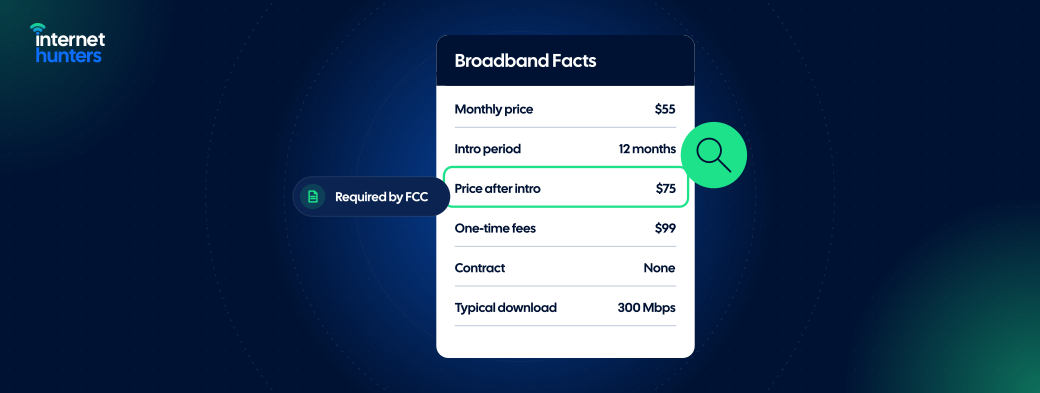
Comparing internet plans used to mean digging through fine print on different websites. The Broadband Facts label puts key plan details in a standard format: price, fees, speeds, and data allowances. Two providers' plans can then be compared field by field.
This guide explains where to find the label and how to read each section. It also covers what the label leaves out and how the label rules changed in 2026.
Why the Label Is Worth Reading
The label helps you:
- Compare like with like: Every label uses the same fields in the same order.
- See the price after a promotion: The label shows how long an introductory rate lasts and what comes next.
- Spot fees early: One-time and monthly provider fees are listed separately from the plan price.
- Check realistic speeds: The label shows typical speeds, not just "up to" figures.
- Find data limits: Allowances and overage charges are disclosed up front.
1. Where to Find the Label
Congress directed the creation of standardized broadband labels in the 2021 Infrastructure Investment and Jobs Act, and they have been required since 2024. Providers must offer a label for every standalone broadband plan.
How the label appears changed in September 2026. Under the revised rules, which took effect on September 14, providers can use a prominent link or icon instead of displaying the full label. This applies at the point of sale and in account portals, as long as the link sits near the advertised plan and leads directly to that plan label. In practice, look for a "Broadband Facts" link next to each plan.
If you order by phone, representatives can now summarize the key label information in conversation instead of reading the whole label aloud. You can always ask for a link to the full label.
2. Read the Pricing Section
Monthly price
The base price for the plan. If it's an introductory rate, the label shows how long it lasts and the price afterward.
Contract terms
Whether a contract is required and for how long, with a link to the terms.
One-time fees
Charges at purchase, such as installation or activation, and any early termination fee.
Provider monthly fees
Recurring charges the provider adds, often for equipment rental.
Taxes and passthrough fees
Passthrough fees, which are third-party costs a provider chooses to pass on to customers, currently must be itemized. A rule of change that would let providers show a single maximum amount, or an exact total for a specific location, has been delayed indefinitely. Government taxes vary by location, so the label may not show your exact amount.
The section on the Affordable Connectivity Program has been removed since the program ended in 2024.
3. Check Discounts and Bundles
Labels link to information about discounts and bundles, such as savings for combining the internet with mobile service. Read the conditions to confirm that you qualify.
4. Look at Speeds and Latency
The label lists typical download speed, typical upload speed, and typical latency. Typical speeds reflect what customers generally get, which can be lower than the advertised "up to" speed. Use them to compare plans and see our guide to How to Run and Interpret a Speed Test to check your own results after installation.
5. Find the Data Allowance
The label shows how much data is included each month and what extra usage costs. If the plan has unlimited data, the label will say so.
6. Use the Policy and Support Links
Labels link to the provider's network management and privacy policies and list customer support contacts. These links are useful if you want to know how the provider handles your data or manages traffic.
7. Compare Two Labels Side by Side
Open labels for the plans you're considering and record the same fields for each:
| Label Field | Question to Ask |
|---|---|
| Monthly price and promotion length | What will I pay after the promotion ends? |
| Contract terms | Am I committing for a fixed period? |
| One-time fees | What will my first bill include? |
| Provider monthly fees | Is equipment included or extra? |
| Typical download and upload speed | Does this fit my household's busiest hour? |
| Typical latency | Will calls and gaming feel responsive? |
| Data included | Is there a limit, and what does extra data cost? |
Our guide to What Home Internet Really Costs shows how to turn these figures into a first- and second-year cost estimate.
What the Label Won't Tell You
The label is a useful tool, but it doesn't cover everything:
- Whether the plan is available at your exact address.
- How well Wi-Fi will perform inside your home.
- How reliable service is in your area.
- Customer service quality.
- Your exact taxes, which depend on location.
Our guide to How to Find Which Providers Serve Your Address covers the first point.
What Changed in 2026
The 2026 order kept the core fields: typical download and upload speeds, latency, data allowances, pricing and contract terms. Labels must still be accessible to people with disabilities and available in any language the provider uses to market its services. The main changes are in how labels are displayed and how some fees will be shown. Broadband Breakfast's summary has more detail, and the FCC's broadband label page explains the program.
| What Changed | What It Means for You |
|---|---|
| Link or icon allowed instead of the full label | |
| Click "Broadband Facts" next to each plan | |
| Phone summaries allowed | Phone summaries allowed |
| Passthrough fee display change (delayed) | Fees remain itemized for now |
| Affordable Connectivity Program section removed | No action needed |
Read the Label Before You Commit
A minute with the label can show you the price after a promotion, the fees and the realistic speeds before you sign up. That makes it one of the most useful comparison tools available.
Internet Hunters explains provider terms, pricing and technology in plain language. Explore our guides to compare plans and choose a service that fits your home.
Frequently Asked Questions
Does every internet plan have a label?
Providers must offer a label for each standalone broadband plan.
Does the label show the price after a promotion ends?
Yes. It shows how long an introductory rate lasts and the price that follows.
Why is the typical speed lower than the advertised speed?
Advertised speeds are often maximums, while typical speeds reflect what customers generally get.
What if my bill includes a charge I can't find on the label?
Ask the provider to explain it. Save a copy or screenshot of the label for the plan you chose in case you need to refer to it.
Did the label rules change recently?
Yes. Revised rules took effect September 14, 2026, mainly changing how labels are displayed. One fee-display change has been delayed.


